
eSIM as an Ancillary Product for Pakistani Hajj and Umrah Tour Operators
by Daniel Dib2 Oct 2026
Pakistan's Ministry of Religious Affairs certified 113 travel agencies for Umrah and Hajj for the 2025-26 season, a regulator-vetted list that represents the entire addressable market for this ancillary product in one place. Thousands of Pakistanis travel to Saudi Arabia for Umrah every month, on top of the annual Hajj quota, almost all of it booked through package tours rather than independent travel.
That package structure is exactly what makes eSIM a natural ancillary add-on for this segment, and exactly why it needs to be sold differently than a standard OTA checkout add-on. A Hajj or Umrah package is typically all-inclusive: flights, accommodation, ground transport, and guided group movement between religious sites are bundled into one price the pilgrim pays well before departure. Connectivity fits the same logic, bundled into the package rather than presented as a separate purchase decision at a moment when the traveler is focused on very different preparations.
This guide covers why the standard OTA ancillary-checkout model does not translate directly to Hajj and Umrah operators, what actually works for this traveler segment, and the specific operational considerations that make this different from selling eSIM to a typical leisure traveler.
Monty Mobile's eSIM Reseller Portal and Travel eSIM infrastructure support both package-bundled and add-on commercial models for Hajj and Umrah operators.
Why Standard Checkout Add-On Logic Does Not Fit This Traveler
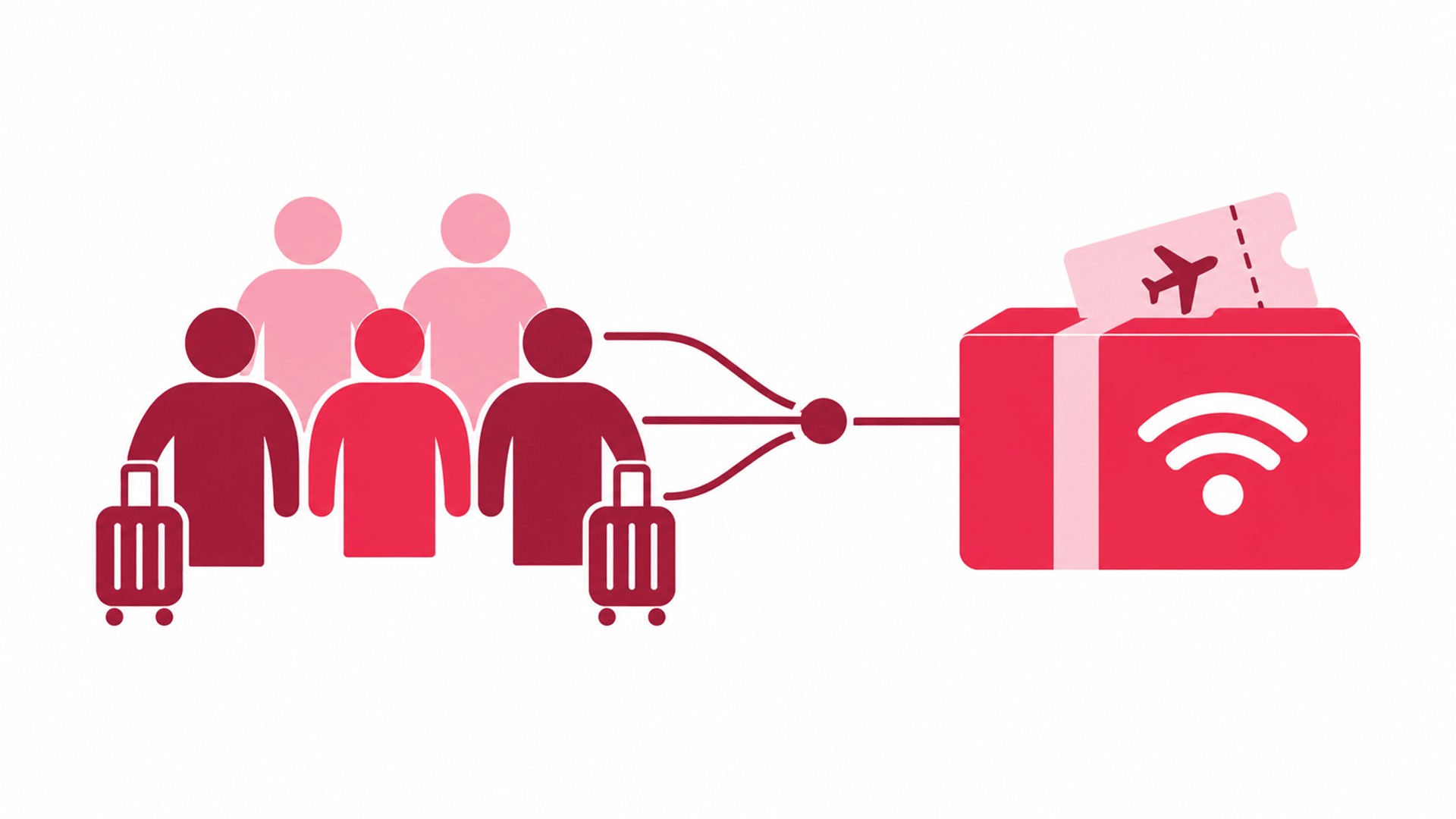
Most travel eSIM guidance assumes a traveler booking independently online, comfortable making a quick add-on decision at checkout. A large share of Hajj and Umrah pilgrims do not fit that profile. Many are traveling internationally for the first time, are older, are traveling in large escorted groups managed by the operator rather than independently, and are focused entirely on religious preparation, not on evaluating a data plan.
Presenting eSIM as an optional checkout add-on to this traveler, requiring them to compare data amounts and make a purchase decision, adds friction at exactly the wrong moment and produces a lower attach rate than the same product would achieve with a leisure traveler booking a city break.
Family members arranging or co-paying for a relative's pilgrimage are also part of this buying pattern in a way that does not apply to typical leisure travel. An adult child booking a parent's first Hajj trip is often making the connectivity decision on the pilgrim's behalf, and that buyer responds to a package that already includes reliable connectivity as a reassurance, not to being asked to select a data plan they may not fully understand themselves.
The Package-Bundling Alternative
Connectivity as a standard package inclusion
Operators that fold a baseline eSIM data allowance directly into the package price, the same way meals and ground transport are included, remove the decision entirely. The pilgrim receives a pre-configured eSIM with their travel documents rather than being asked to choose one.
Pre-activation and group provisioning
For operators managing large groups, the practical requirement shifts from individual checkout flows to bulk provisioning: activating eSIM profiles for an entire group ahead of departure, distributed alongside other travel documents, rather than expecting each pilgrim to self-activate on arrival.
Simple, guided activation for less tech-comfortable travelers
Where self-activation is required, instructions need to assume minimal smartphone familiarity, printed step-by-step guidance in Urdu alongside English, rather than a QR code and an app-store link with no further explanation.
Network Conditions During Peak Hajj Days
Millions of pilgrims converge on a small geographic area around Mecca and Mina during the days of Hajj itself, producing network congestion that no single eSIM plan can fully solve, since it is a capacity constraint on the ground, not a coverage gap. What a well-provisioned eSIM can offer is access tuned to the most reliable local network available in that specific area during peak periods, and operators should ask their connectivity provider directly about performance during past Hajj seasons rather than assuming standard travel eSIM coverage claims translate to Hajj-week conditions specifically.
Umrah travel, spread across the rest of the year rather than concentrated into a single week, does not face this same acute congestion pattern, which is a meaningful operational difference between the two segments worth factoring into how each is provisioned.
Setting realistic expectations with pilgrims and their families ahead of departure matters here too. A package that promises seamless connectivity throughout Hajj week without acknowledging the genuine capacity constraints around Mina and Arafat sets an expectation the network itself cannot meet during those specific days, regardless of provider quality, and an operator that explains this upfront avoids complaints that a connectivity issue outside anyone's control caused.
Deployment Example: MoRA-Certified Operator Bundling eSIM Into Umrah Packages
A Pakistani Umrah tour operator on the Ministry of Religious Affairs certified list wanted to add connectivity as a package feature rather than a checkout add-on, aiming to differentiate its packages in a competitive, price-sensitive market.
The operator negotiated a per-pilgrim wholesale rate for a baseline data allowance covering the typical Umrah trip duration, built into every package tier rather than sold separately, and worked with its wholesale provider to pre-provision and bulk-activate eSIM profiles ahead of each group's departure date.
The operator reported that marketing the package as including connectivity, alongside meals and transport, resonated with pilgrims and their families arranging the trip on their behalf, who valued knowing a first-time traveler would stay reachable without navigating a foreign SIM purchase alone.
Note: This is an anonymized deployment scenario based on typical implementation outcomes. Specific results vary by implementation, audience quality, and market conditions.
Compliance and Operational Considerations
Getting Started: eSIM as a Package Inclusion for Hajj and Umrah Operators
1. Decide between bundled inclusion and optional add-on. For this traveler segment, bundling into the package price generally outperforms an optional checkout add-on.
2. Confirm bulk pre-provisioning capability with your wholesale partner. Group activation ahead of departure is the practical requirement for most Hajj and Umrah operators, not individual self-service activation.
3. Prepare guided, Urdu-language activation materials as a fallback. For any traveler who does self-activate, assume minimal smartphone familiarity in the instructions provided.
4. Ask about network performance during past Hajj seasons specifically. Standard coverage claims do not capture peak-congestion performance around Mecca and Mina during Hajj week.
Contact Monty Mobile's travel team to discuss bulk provisioning and package-bundled eSIM for your Hajj or Umrah operation.

About the Author
Daniel Dib is Senior Brand Manager at Monty Mobile, a global telecom solutions provider with 25+ years of MNO relationships across 120+ countries. He leads go-to-market strategy and content across Monty Mobile's CPaaS, A2P Wholesale SMS, and Travel eSIM product lines.
Frequently Asked Questions
Should Hajj and Umrah operators sell eSIM as a checkout add-on or bundle it into the package?
Bundling it into the package price generally works better for this traveler segment. Many pilgrims are first-time international travelers or are less comfortable evaluating a data plan at checkout, and an included connectivity feature removes that decision entirely rather than adding friction.
How does eSIM provisioning work for a large Hajj or Umrah group?
Operators typically arrange bulk pre-provisioning with their wholesale partner, activating eSIM profiles for an entire group ahead of departure rather than expecting each pilgrim to self-activate individually on arrival.
Does network congestion during Hajj affect eSIM performance?
Millions of pilgrims converge on a small area during Hajj week, which creates real network capacity constraints that no eSIM plan alone resolves. What matters is whether the provider's coverage is tuned to the best-performing local network available during that specific period; ask directly about past Hajj-season performance rather than relying on general travel coverage claims.
Which Pakistani travel agencies are authorized to sell Umrah and Hajj packages?
Only agencies certified by Pakistan's Ministry of Religious Affairs, currently numbering around 113 for the 2025-26 season, may legally operate Umrah and Hajj packages. The certified list is publicly maintained and updated periodically.