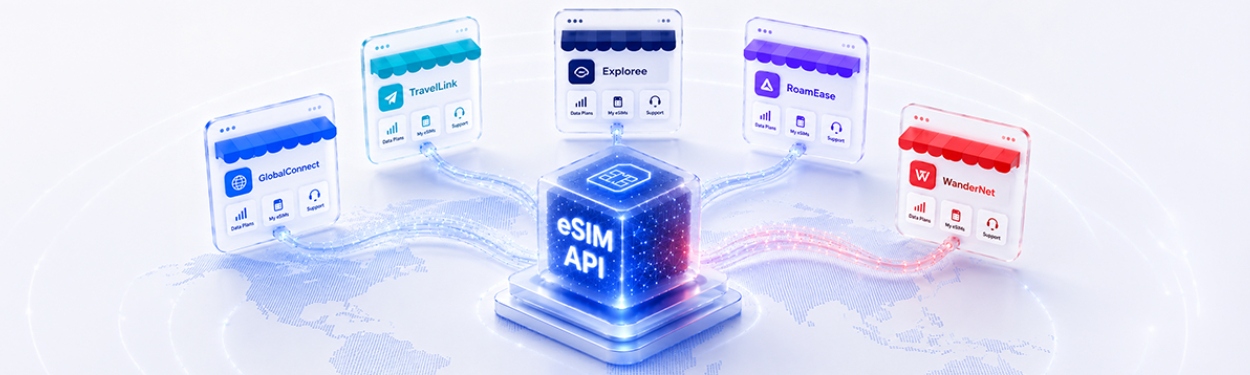
eSIM API Provider: Embedding Connectivity Into OTA and Fintech Booking Flows
by Daniel Dib15 Jul 2026
The connectivity decision is moving earlier in the customer journey. Travel eSIM revenue reached $1.8 billion in 2025, growing 85% from $989 million in 2024, according to Juniper Research, and a large share of that growth is now happening at the point of booking rather than after arrival. Juniper Research forecasts that the number of devices using eSIMs will grow 30% in 2026 alone, rising from 1.2 billion in 2025, though it is worth noting that growth is led primarily by enterprise IoT use cases (logistics, energy, smart infrastructure) rather than consumer travel handsets specifically. On the consumer side, nearly one in three international travelers is expected to use travel eSIMs by 2030, according to Kaleido Intelligence's Travel Data Hub 2025 survey, which is the more direct signal for how fast the API-activatable travel device base is actually growing. Platforms that move connectivity earlier into the booking flow, rather than leaving it as a post-arrival decision, are positioned to capture a meaningful share of that shift before it becomes table stakes.
For OTAs, fintechs, and travel-tech platforms, this shift creates a build-versus-buy decision. Building telecom infrastructure from scratch (carrier agreements, SM-DP+ provisioning servers, regulatory licensing) takes years and capital most travel and fintech companies do not have a reason to deploy. An eSIM API provider closes that gap: a single integration point that gives a platform programmatic control over provisioning, activation, and plan management, without owning any of the underlying telecom infrastructure.
This article covers how eSIM APIs work technically, what an integration looks like for OTAs and digital wallets, and what to evaluate when selecting a provider.
Monty Mobile's eSIM Consumer Platform and eSIM Entitlement Server give partners API-level access to provisioning, activation, and plan management built on direct carrier relationships.
How an eSIM API Provider Works at Deployment Scale
The GSMA's SGP.22 specification defines the Remote SIM Provisioning (RSP) architecture that underlies every consumer eSIM API on the market. The architecture has three core components. The eUICC is the embedded chip on the device that stores operator profiles. The SM-DP+ (Subscription Manager Data Preparation) server prepares and securely delivers operator profiles to the device. The SM-DS (Subscription Manager Discovery Server) helps route devices to the correct SM-DP+ during activation. An eSIM API provider exposes this entire stack as a set of REST endpoints, so a developer can trigger profile creation, activation, usage monitoring, and deactivation through standard API calls instead of managing telecom infrastructure directly.
A typical eSIM API integration follows an order, provision, activate, monitor sequence. The platform calls an order endpoint to purchase a data plan for a specific destination and duration. The API returns a profile reference, typically delivered as a QR code or an activation code string. The customer scans the code or taps an in-app activation button, which triggers the device to communicate with the SM-DP+ server and download the profile. The platform can then poll a status endpoint or receive a webhook notification confirming activation, and usage data becomes available through a reporting endpoint for the duration of the plan.
Coverage availability, delivery rates, and service features may vary by country and are subject to local operator agreements, regulatory requirements, and network conditions. Contact Monty Mobile for specific market capabilities.
Through the Monty Mobile eSIM Entitlement Server, partners get programmatic control over plan provisioning and entitlement management, built on direct carrier interconnects rather than aggregated third-party capacity.
OTAs: Embedding eSIM Provisioning Into the Booking Confirmation Flow
The technical integration point for an OTA is almost always the booking confirmation step, the moment a flight, hotel, or package purchase is finalized. Travelers have historically delayed securing connectivity until arrival, buying a local SIM at the airport or relying on hotel Wi-Fi rather than deciding on a data plan during booking itself, a pattern sometimes called booking lag. Embedding eSIM provisioning directly into the booking confirmation step, rather than leaving it as a separate post-arrival decision, turns mobile data from a last-minute utility into a high-frequency, branded touchpoint built into the purchase flow itself.
Webhook-driven activation confirmation
Rather than requiring the OTA's front end to poll the API repeatedly for activation status, a well-designed eSIM API provider sends webhook notifications at each stage of the provisioning lifecycle: order confirmed, profile ready, profile activated, usage threshold reached. This lets the OTA's backend update the customer's booking record automatically and trigger downstream actions, like sending a confirmation email with activation instructions, without manual intervention.
Multi-destination itinerary support
Travelers on multi-country itineraries need plans that span more than one destination. A capable eSIM API exposes regional and multi-country bundle options as distinct product types in the order endpoint, so an OTA selling a European rail itinerary across four countries can offer a single regional data plan rather than forcing the customer to buy four separate single-country eSIMs.
Sandbox testing before production
Before going live, OTA engineering teams need to validate the full order-to-activation flow without provisioning real eSIMs or incurring charges. A sandbox environment with mock order responses and simulated webhook events lets the integration team build and test the checkout flow safely, catching edge cases in cancellation, refund, and partial-itinerary scenarios before customer-facing launch.
For transportation and travel platforms building connectivity into existing booking systems, see Monty Mobile's Transportation solutions.
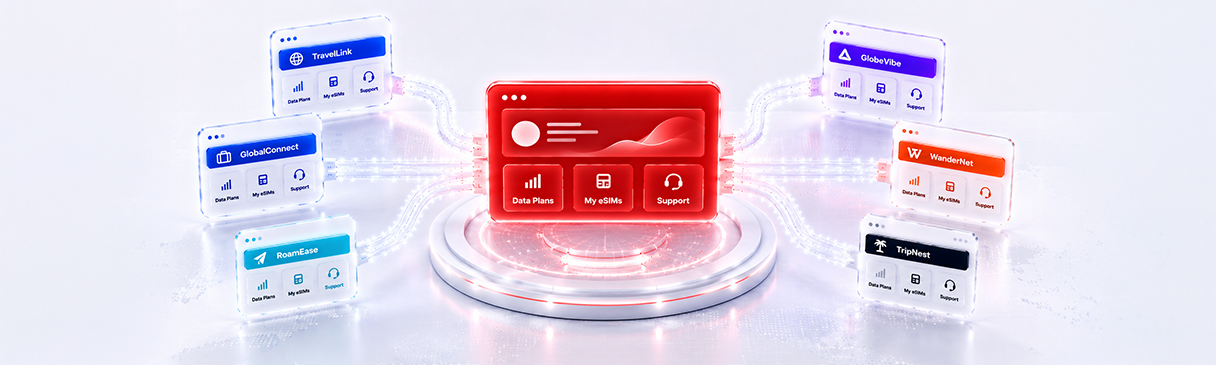
Digital Wallets and Fintechs: API-Native Connectivity Inside the App
Digital wallets and fintech apps approach eSIM API integration differently than OTAs because the connectivity feature usually lives inside an existing app rather than a transactional checkout flow. Connectivity is one of the more natural adjacent features for a fintech to add, since a customer who already trusts an app with their money is a reasonable candidate to trust it with their mobile data too. Revolut illustrates how deep this integration runs in practice: its travel eSIM launched in 2024, and by 2025 it had expanded into full monthly mobile plans, both requiring real API-level integration into existing account and spend infrastructure rather than a simple bolt-on widget. N26 followed a similar path, announcing its own eSIM-based mobile plan, N26 SIM, in May 2025.
OAuth2-based authentication for secure provisioning
Fintech platforms operate under stricter security and compliance expectations than most travel apps, so the API authentication model matters more. OAuth2 client credentials flows with short-lived access tokens, typically expiring within 15 minutes and refreshed automatically, reduce the exposure window if a token is compromised and align with the security posture fintech compliance teams expect from any third-party integration touching customer data.
Usage-based entitlement for premium tiers
A wallet offering eSIM data as a premium account benefit needs entitlement logic tied to account tier rather than a simple one-time purchase. The API supports this through allocation endpoints, where the platform can grant a customer a defined data allowance per billing cycle, track consumption against that allowance, and trigger top-up prompts when the customer approaches the limit, all without the customer leaving the wallet app.
Centralized expense and usage reporting
For wallets serving business or corporate account holders, API-level access to usage and cost data across all provisioned eSIMs supports centralized expense reporting. A finance team managing connectivity for a distributed workforce can pull consolidated usage reports through the reporting endpoint rather than requesting data from individual users.
Regulatory note: Digital wallet and fintech platforms integrating eSIM connectivity must evaluate whether the integration constitutes a telecommunications resale activity under local law and confirm data handling practices align with applicable financial services data protection requirements in each operating market.
For financial services platforms evaluating API-based connectivity integration, see Monty Mobile's Finance industry solutions.
eSIM Resellers and Travel-Tech Platforms: Building a Product on Someone Else's Infrastructure
Travel-tech platforms and dedicated eSIM resellers use the same underlying API differently than OTAs and wallets: connectivity is the core product, not an add-on. A direct API integration offers full control and automation across ordering, activation, user management, and payments, compared with hosted no-code storefront options that trade integration depth for faster time to market.
Choosing API depth versus hosted storefront
Resellers face a genuine trade-off between a full API integration and a hosted, no-code storefront. The API path gives complete control over the customer experience, checkout flow, and branding, but requires engineering resources to build and maintain. The hosted storefront path launches faster, sometimes within 48 hours, but limits customization to what the provider's storefront templates support. Platforms with engineering capacity and a long-term connectivity product roadmap typically choose the API path. Platforms testing the market or without dedicated engineering resources often start with a hosted storefront and migrate to API integration once volume justifies the investment.
Webhook reliability for high-volume operations
At scale, a reseller processing hundreds of orders per day needs webhook delivery that survives network interruptions. HMAC-signed webhooks with exponential backoff retry logic ensure that a temporary outage on the reseller's receiving endpoint does not result in silently dropped activation confirmations, which would otherwise create support tickets and refund requests.
Rate limits and throughput planning
API providers typically publish default throughput limits, often in the range of a few hundred orders per day, with enterprise tiers available for higher volume. Resellers planning rapid growth should confirm throughput ceilings and escalation paths with their provider before launch rather than discovering a rate limit during a peak booking period.
For reseller program details and infrastructure access, see Monty Mobile's eSIM Reseller Portal.
Deployment Example: Travel-Tech Platform Cuts Activation Failures Through Webhook Redesign
A travel-tech platform serving corporate travel management clients across the Gulf and broader Middle East region had integrated an eSIM API into its booking and expense system roughly a year prior, using a polling-based status check rather than webhooks. The polling approach worked at low volume but began producing a measurable rate of failed activations as booking volume scaled, because the platform's polling interval occasionally missed the narrow window between profile readiness and customer attempt to activate.
The engineering team redesigned the integration around webhook-driven status updates instead of polling, subscribing to order.completed, esim.activated, and usage.threshold events directly from the API provider. This eliminated the polling delay entirely and let the platform's backend update booking records the moment an activation event fired, rather than on the next scheduled poll cycle.
Within the first 60 days after the redesign, activation failure reports dropped by approximately 70%, and average time from purchase to confirmed activation fell from several minutes to under 30 seconds. Support tickets related to “eSIM not working” dropped correspondingly, since most of the original failures were not provisioning failures at all but timing gaps in the platform's own status tracking.
Note: This is an anonymized deployment scenario based on typical implementation outcomes. Specific results vary by implementation, audience quality, and market conditions.

Compliance Requirements for eSIM API Integration
Platforms integrating an eSIM API carry compliance responsibilities distinct from the underlying infrastructure provider's obligations.
Monty Mobile's API infrastructure is built on GSMA-certified provisioning systems, and the technical integration team supports partners through sandbox testing and security review before production deployment.
Getting Started: eSIM API Integration for OTAs, Wallets, and Travel-Tech Platforms
- eSIM RSP API access. Partners receive API credentials, OAuth2 client details, full endpoint documentation, and sandbox access for building and testing the order, provisioning, and activation flow before any production traffic touches the integration.
- Coverage and plan configuration. Through the API or the accompanying portal, partners configure which destinations, single-country and regional bundle types, and price points are exposed to their integration, keeping the available catalog aligned with their actual customer base.
- Checkout or app integration. Partners build the order, activation, and status-tracking flow into their existing booking confirmation step or in-app experience, using webhook subscriptions rather than polling wherever order volume is meaningful.
- Provisioning and support setup. Once live, provisioning runs automatically through the API. Partners handle customer-facing support for their own branded experience, while infrastructure-level issues, including provisioning failures or carrier-side outages, route to the provider's technical escalation channel.
Sample webhook payload structure for an activation confirmation event:
{
"event": "esim.activated",
"order_id": "ord_8f2a91",
"iccid": "8943[REDACTED]",
"destination": "ES",
"activated_at": "2026-06-17T10:32:00Z",
"data_allowance_mb": 5120
}
This payload format lets the receiving system update booking or account records immediately on activation, without a separate status lookup call.
White label eSIM is one component of a broader connectivity strategy for travel and fintech platforms. For platform brand ownership and storefront configuration, see also: White Label eSIM: How OTAs, Resellers, and Digital Wallets Launch Branded Connectivity (montymobile.com/blog/white-label-esim-platform-otas-resellers).
Contact Monty Mobile through the partner inquiry page to request API documentation and sandbox access.

About the Author
Daniel Dib is Senior Brand Manager at Monty Mobile, a global telecom solutions provider with 25+ years of MNO relationships across 120+ countries. He leads go-to-market strategy across Monty Mobile's CPaaS, Travel eSIM, and A2P Wholesale SMS product lines, including the technical partner integrations that connect Monty Mobile's eSIM infrastructure into OTA and fintech platforms.
Frequently Asked Questions
What is an eSIM API provider?
An eSIM API provider exposes the technical infrastructure behind remote SIM provisioning, profile management, and activation as a set of REST endpoints that a platform's own engineering team can integrate directly into its product, rather than relying on a hosted storefront or manual provisioning process.
How does an eSIM API integration differ from a white label reseller program?
A white label reseller program typically provides a hosted, brandable storefront that requires minimal engineering effort to launch. An eSIM API integration gives the platform full programmatic control over the order, provisioning, and activation flow, embedded directly into an existing app or booking system, but requires dedicated engineering resources to build and maintain.
What volume of eSIM orders requires an enterprise API tier?
Default API tiers typically support a few hundred orders per day before throughput limits apply. Platforms expecting consistent volume beyond a few hundred daily orders, or anticipating seasonal spikes during peak travel periods, should confirm enterprise throughput terms with their provider before launch.
What compliance obligations apply to platforms integrating an eSIM API?
Platforms must confirm the underlying infrastructure is GSMA SGP.22 compliant, implement appropriate data protection measures for activation and usage data collected through the API, apply standard API security practices including OAuth2 authentication and signed webhooks, and review telecommunications reseller licensing requirements in each market where the platform operates.