
Remote Healthcare Runs on Connectivity: Care Beyond the Hospital
by Monty Holding Staff7 Oct 2026
Monty Mobile: The Future of Remote Healthcare Won't Be Built Inside Hospitals
A woman in her seventies checks her blood pressure before breakfast. The reading travels instantly to a cardiologist's dashboard two hundred miles away, gets reviewed, and is closed out before she's finished her coffee.
She never left her kitchen. Nobody scheduled an appointment. Nothing about this required a waiting room, a parking garage, or a morning off work.
This is what remote healthcare looks like when it works: invisible, uneventful, almost boring. And it's happening far more often than most people outside the industry realize, not as a leftover pandemic workaround, but as a permanent redrawing of where medicine happens.
The stakes are straightforward. Health systems, device makers, and digital health platforms that treat this shift as a feature to bolt onto existing infrastructure will spend the next decade catching up to the ones that treat it as the infrastructure itself.
The Remote Healthcare Trend Is Already Validated
The shift is not speculative, and it isn't slowing down. Grand View Research recently valued the global digital health market at $347.4 billion in 2025, projecting it to reach $1.83 trillion by 2033, a 23.4% compound annual growth rate pulled largely by telehealth, remote monitoring, and connected care technologies.
Telehealth specifically is valued at $77.4 billion in 2025, on track to grow to $187.5 billion by 2033, an 11.5% CAGR, according to the same research.
Connectivity is doing more of the lifting than most digital health conversations acknowledge. GSMA reports that 4.7 billion people, 58% of the world's population, now use mobile internet, and that essential services, healthcare included, are most commonly accessed on a mobile device rather than a desktop or an in-person visit.
Health system leaders are already voting with their budgets. In Deloitte's 2026 Global Health Care Outlook, nearly half of surveyed executives said they expect savings from tech-enabled patient engagement and remote monitoring in the year ahead, and health systems more broadly are accelerating the shift of care toward lower-cost, higher-efficiency settings, expanding outpatient services, virtual care, and remote monitoring for at-home care.
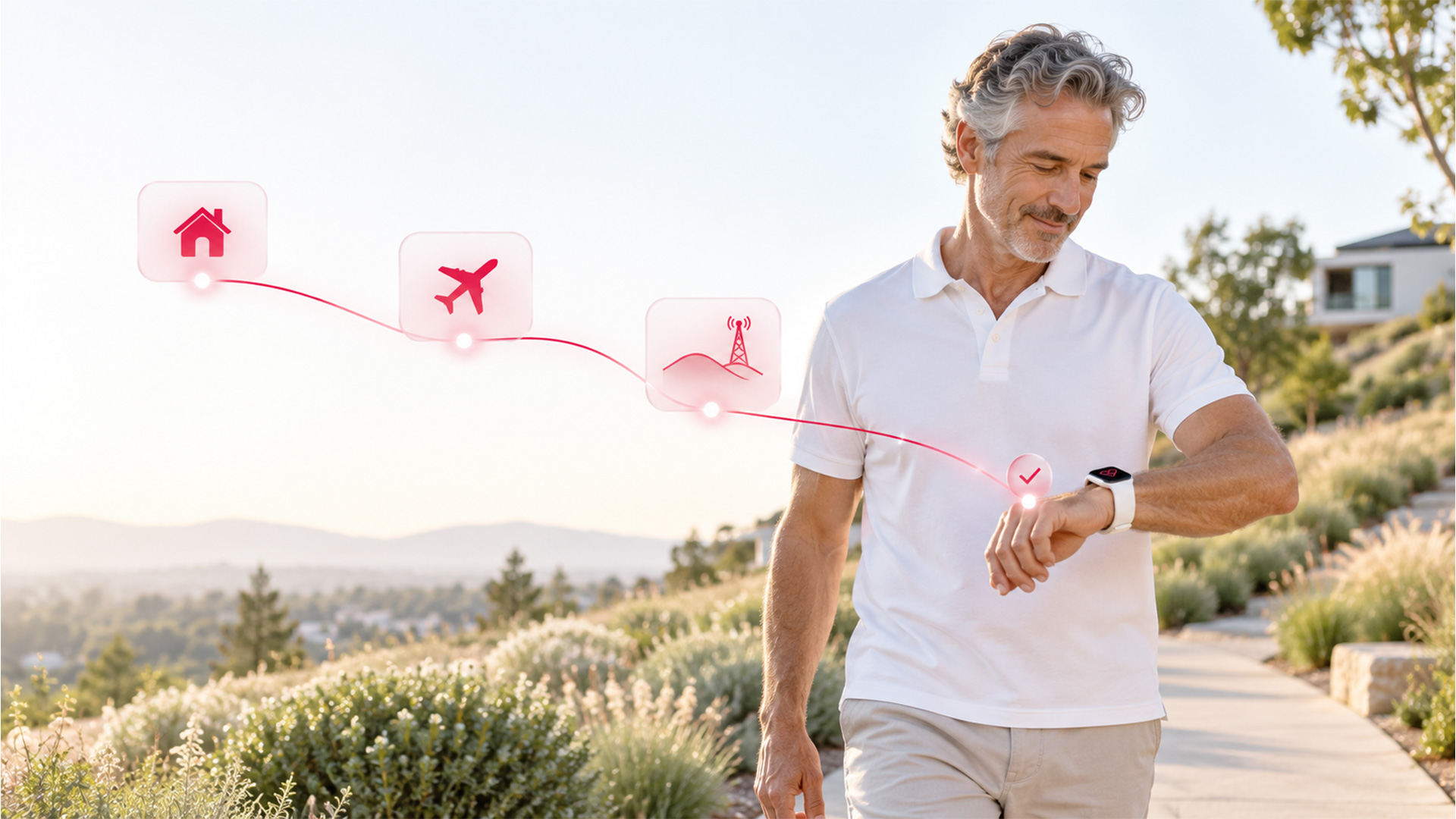
The platforms that treat mobile connectivity as core infrastructure, not an afterthought, stand to capture a disproportionate share of that growth, and the ones that don't will find their monitoring devices, apps, and virtual visits quietly failing at the exact moments’ patients need them most.
The Precedent: What Banking Already Learned
To understand what's coming in healthcare, it helps to look at what already happened in banking. Twenty years ago, a bank was a building.
Today, most banking relationships never touch a branch; they live inside an app, a card, a push notification.
That transition didn't happen because banks decided branches were obsolete overnight. It happened because the infrastructure underneath banking (payment rails, mobile networks, authentication systems) matured to the point where physical distance stopped being a barrier to trust.
Once the infrastructure was reliable enough, the service followed it out of the building, and the branch became one channel among several rather than the whole relationship.
Now watch what's happening with healthcare. The clinical expertise, the diagnostic tools, even the trust patients place in their providers: none of that strictly needs to live inside a hospital anymore.
What's changing is whether the infrastructure underneath care delivery is dependable enough to carry it outside those walls, the same way payment rails once carried banking out of branches.
Remote Patient Monitoring: The Long Game
Nowhere is this more visible than remote patient monitoring: wearable sensors, cardiac patches, glucose monitors, and connected devices that track a patient's vitals continuously instead of once a year during a check-up.
Grand View Research values the global remote patient monitoring system market at $30.9 billion in 2026, projecting it to reach $110.7 billion by 2033, a 20% CAGR spread across North America, Europe, and a fast-growing Asia Pacific region.
That's an enormous volume of continuous health data, and it doesn't travel over hospital networks. It moves over whatever connection a patient happens to have in the moment: home Wi-Fi, a mobile network, a hotel connection while traveling, a spotty signal in a rural county. When that connection drops, so does the entire point of monitoring: a missed glucose spike, an arrhythmia that goes unflagged, a chronic condition tracked with gaps a clinician can't see around.
This is where digital patient engagement quietly breaks down, and where most healthcare IoT solutions still fall short.
A remote monitoring device that only performs reliably on the network it shipped with is a device that fails exactly when a patient's life doesn't stay still.
What's usually missing isn't better sensors or smarter algorithms: it's a connectivity layer built to follow the patient, not the building.

The Industry Answer: Connectivity Platforms Built for This Exact Gap
Device manufacturers build sensors. Electronic health-record vendors build software. Historically, neither has owned the layer that decides whether a reading actually reaches a clinician in real time, wherever the patient happens to be standing, and that gap has quietly slowed the industry down.
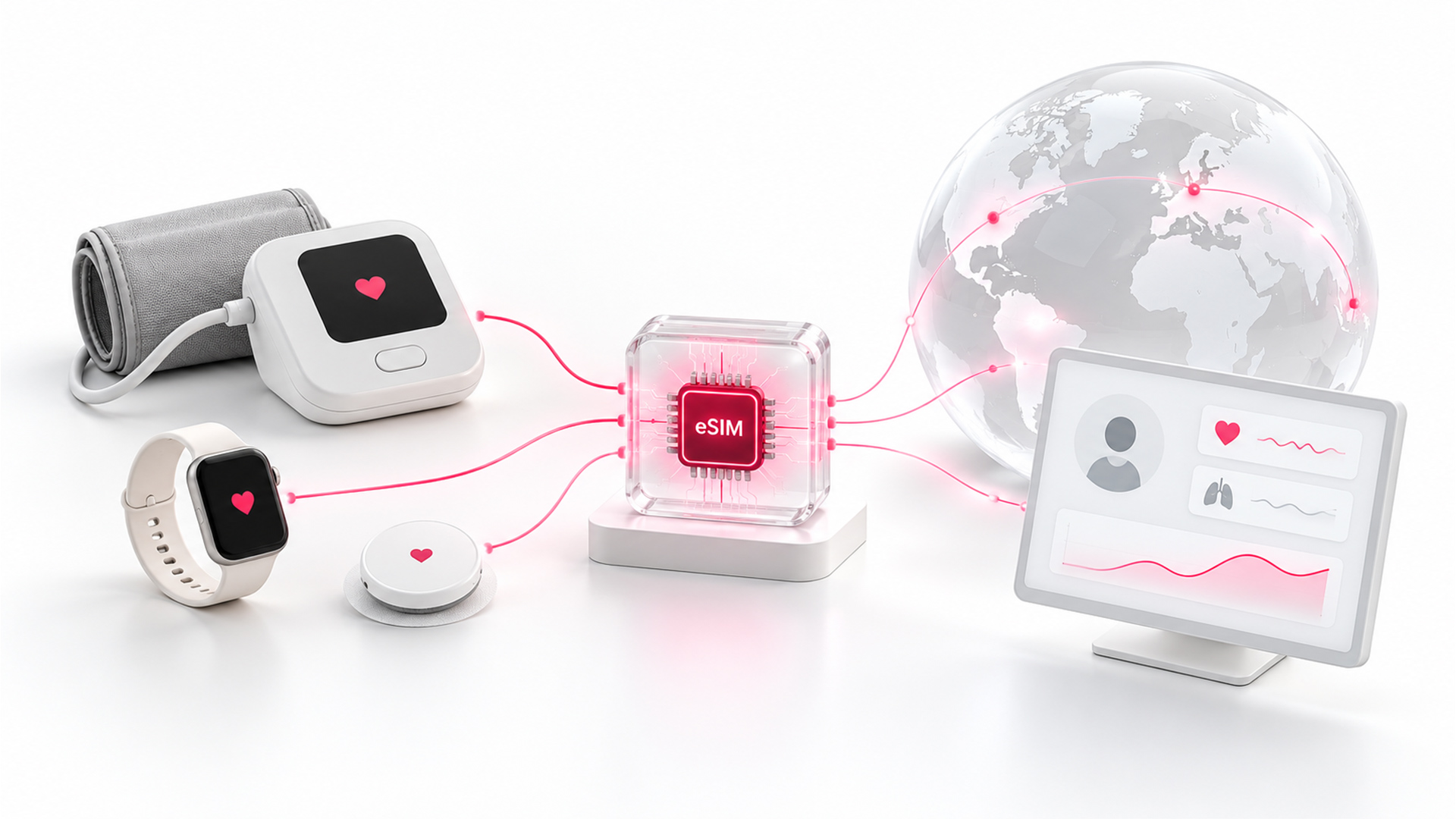
A newer category of connectivity platforms is closing it. Rather than negotiating carrier agreements market by market, health-tech companies can now plug into an eSIM-based connectivity layer through a single API, giving a monitoring device or telehealth app the same always-on reach across borders and carriers that a hospital's own network has inside its walls.
The infrastructure to support this is scaling quickly. GSMA puts global eSIM penetration in smartphones at 5% at the end of 2025, projecting it to double to 10% by the end of 2026, with 73% of mobile network operators already offering commercial eSIM support. On the device side, Juniper Research forecasts that the number of IoT devices using eSIM technology will grow 30% in 2026 alone, rising from 1.2 billion connections in 2025, a category that increasingly includes the kind of connected medical hardware discussed here.
The business case is straightforward. Faster market entry, since a health-tech platform can reach a new country in weeks rather than negotiating its way through dozens of local operators.
A better patient experience, since connectivity activates automatically rather than requiring a patient to manage a second SIM or a roaming plan alongside their monitoring device. And real operational efficiency, since intelligent network routing keeps a device connected to whichever carrier performs best in a given location, without manual intervention.
None of this requires health-tech companies to become telecom companies themselves: it requires choosing a connectivity partner that already is one.
A Pattern Already Playing Out
This shift mirrors what's already happened in other connected-device categories. Consumer wearables added embedded cellular connectivity once Wi-Fi-only syncing proved too unreliable for continuous use. Logistics and asset-tracking companies moved the same way, embedding SIMs directly into hardware rather than relying on a customer's own network.
Healthcare is simply the highest-stakes version of the same problem: a device that only works when conditions are ideal is a device that will eventually fail exactly when it matters most.
Medical device manufacturers are starting to treat connectivity the way they already treat battery life or data security: a core spec, decided at the design stage, rather than something left to whichever network a patient happens to be on.
A cardiac monitor prescribed in one country increasingly needs to keep working if that patient relocates, retires abroad, or simply travels for a few weeks: use cases that barely existed for medical hardware a decade ago and are now common enough to design around.
Telehealth platforms expanding into multiple countries are running into this early, discovering that a video visit or a monitoring integration that works flawlessly in one market can degrade the moment a patient or clinician crosses onto an unfamiliar network.
Where Monty Mobile Fits
This is the layer the Monty eSIM Hub is built for.
Rather than a monitoring device or a clinical platform, it operates as the connectivity infrastructure underneath both, built on eSIM technology and intelligent multi-network routing designed to keep a connected health device online across borders and carriers without the patient or provider ever having to think about it.
The moment a monitoring device or a telehealth app needs a phone call to a carrier just because a patient crossed a border, the whole promise of remote care falls apart. Connectivity has to be the part of this system nobody notices; it should just work, everywhere, all the time.
Health-tech companies, device manufacturers, and telehealth platforms can embed this connectivity through an API rather than negotiating with carriers market by market.
The interconnects, the multi-IMSI routing, and the carrier relationships spanning 200+ countries already exist inside this kind of platform: infrastructure that used to take years of individual carrier negotiations to build, now available to plug into directly rather than rebuild from scratch.
The Remote Healthcare Window Is Still Open
Industries rarely announce their turning points while they're happening.
Healthcare's shift outside hospital walls is already underway: visible in the market data, and in every patient checking a glucose reading from their kitchen table instead of a clinic waiting room.
What hasn't happened yet is a clear category leader in the connectivity layer that makes distributed, remote healthcare genuinely dependable.
The platforms, providers, and device makers that treat connectivity as core infrastructure now (rather than an operational detail to patch later) will be the ones patients and providers trust once remote healthcare stops being framed as an alternative to hospital visits and simply becomes how healthcare works.
About Monty Mobile
As a global telecom technology enabler, Monty Mobile sits at the intersection of connectivity, intelligence, and innovation, partnering with mobile operators, enterprises, and hyperscalers to protect revenues, unlock growth, and accelerate digital transformation.
Built entirely in-house, our solutions span messaging, connectivity, fintech, and AI-backed fraud prevention, including CPaaS and eSIM ecosystems and platforms, along with operator management and advanced analytics, giving operators and enterprises the tools to compete, scale, and lead in an evolving digital landscape.
Trusted by thousands of partners, with longstanding relationships across leading international enterprises and operators, Monty Mobile delivers proven performance in more than 200 countries, reaching over 1.8 billion mobile subscribers worldwide.
Headquartered in London, with 15 regional offices across Africa, Asia, Europe, and the Middle East, we combine global scale with local proximity to deliver solutions that are fast, resilient, and built for the long term.
For more information, visit www.montymobile.com and connect with us on LinkedIn.
About Monty eSIM
Monty eSIM is a global connectivity enabler for consumers, operators, and enterprises. It offers a travel eSIM application for end users alongside the Monty eSIM Hub, a wholesale platform that enables operators, enterprises, and digital platforms to launch and scale connectivity services. Active across 200+ countries and regions, Monty eSIM simplifies how connectivity is delivered and scaled through capabilities such as a single global eSIM, multi-IMSI, intelligent routing, and always-on connectivity.
FAQ
What is remote patient monitoring and how does it work?
Remote patient monitoring uses connected devices, including wearables, cardiac patches, glucose sensors, and blood pressure cuffs, to track a patient's vital signs continuously and transmit that data to a clinician without an in-person visit. The device captures a reading, sends it over a mobile or Wi-Fi connection to a monitoring platform, and flags anything outside normal range for clinical review. Its value depends entirely on that connection staying live, since a gap in transmission is a gap in care.
What is mobile health (mHealth)?
Mobile health, or mHealth, refers to healthcare services and information delivered through mobile devices: apps for medication reminders, virtual consultations, symptom tracking, and connected wearables. It has grown alongside smartphone adoption and now touches everything from chronic disease management to mental health support. Because mHealth depends on a live mobile connection to function, connectivity reliability shapes how effective it actually is in practice.
What are healthcare IoT solutions?
Healthcare IoT solutions are networks of connected medical devices, including monitors, infusion pumps, wearables, and diagnostic tools, that collect and share data automatically, without manual entry. They're used in hospitals, home care, and increasingly in patients' daily lives as monitoring moves outside clinical settings. Their usefulness scales directly with how consistently they can stay connected across different locations and networks.
How does connectivity affect digital patient engagement?
Digital patient engagement (apps, portals, and messaging that keep patients involved in their own care) only works if patients can reliably access it. A dropped connection during a scheduled telehealth visit, or a monitoring app that stops syncing while traveling, quietly erodes the trust that engagement tools are meant to build. Reliable, always-on connectivity is what keeps digital engagement tools functional rather than frustrating.
Let's Talk Partnerships
Health-tech platforms, device manufacturers, and telehealth providers looking to build always-on connectivity into their products can get in touch with our partnerships team to explore how the Monty eSIM Hub fits into their roadmap.