_1784792028.png)
The Next Billion Dollars in Airline Revenue May Be Digital
by Myrna Beaini23 Jul 2026
For decades, the airline industry has operated on one of the thinnest margins in global commerce. IATA data consistently shows the average net profit per passenger sitting at $7.90; roughly the price of an airport coffee. Airlines have responded with relentless ingenuity: unbundling fares, monetizing legroom, selling priority boarding, and building loyalty ecosystems that generate more revenue than some mid-sized banks.
They have turned the aircraft cabin into a retail environment and the booking flow into a digital marketplace. And yet, with all of that, one revenue opportunity remains almost entirely untapped: embedded connectivity at the destination.
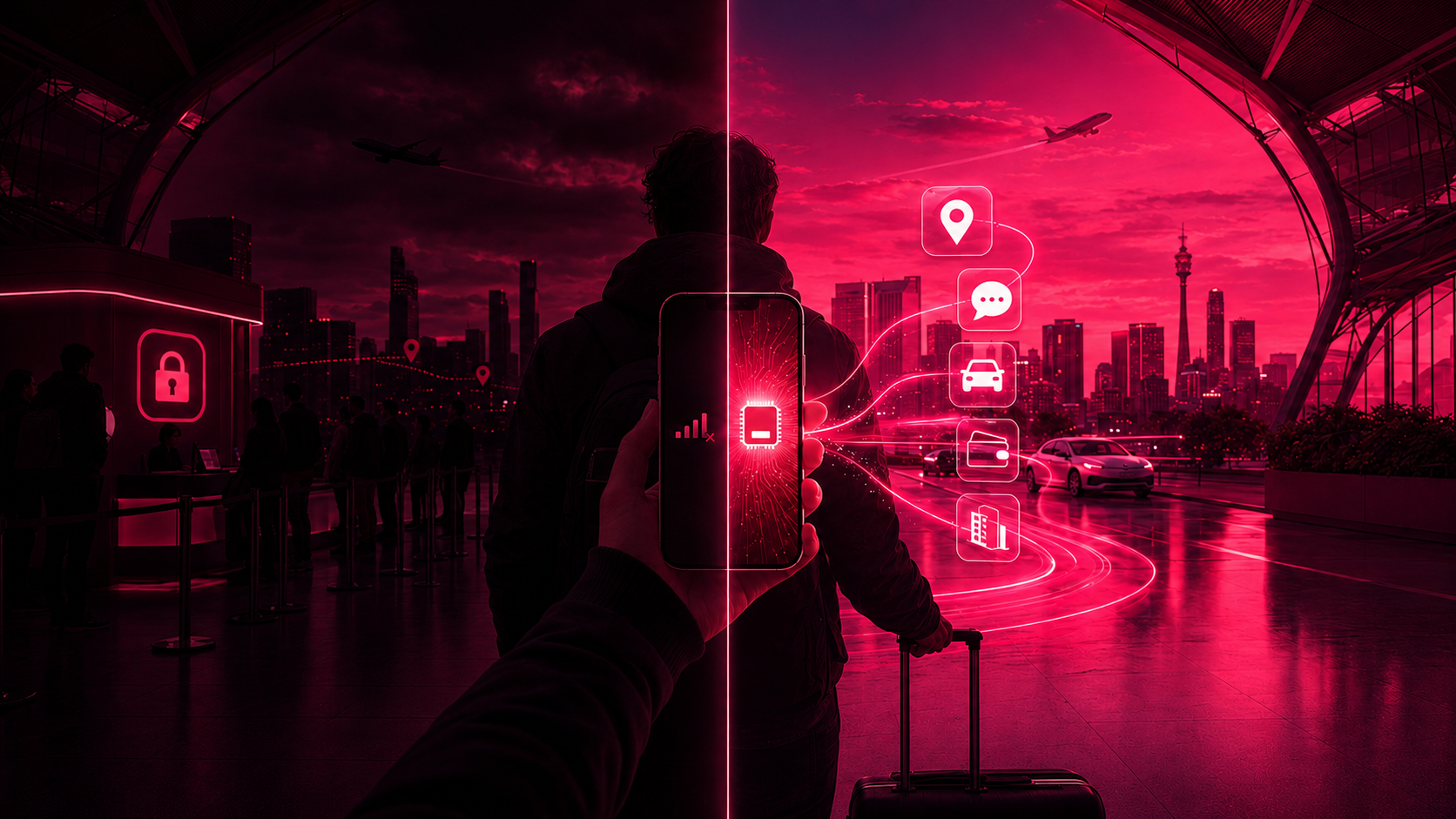
The moment a passenger lands at their destination, the airline's commercial relationship with that traveler effectively ends. The app goes quiet, the notifications stop, and the opportunity to engage, upsell, or add value vanishes. Right when the traveler needs help most.
In a world where airline digital transformation has optimized nearly every touchpoint of the pre-flight experience, the post-landing gap represents a structural blind spot. Closing it may be the most consequential commercial decision the industry makes this decade.
Ancillary Revenue: A Story Still Being Written
The growth of airline ancillary revenue over the past decade is one of the more remarkable commercial transformations in any industry.
According to IdeaWorksCompany's 2025 Yearbook of Ancillary Revenue, total global ancillary revenue surpassed $148 billion in 2024. IATA's December 2025 financial outlook confirms that ancillary services now account for nearly 14% of total industry revenue, up from 12–13% before the pandemic. McKinsey puts the longer arc into perspective: ancillary revenue's share of the industry has grown from approximately 5% in 2010 to approximately 15% in 2024; roughly tripling in fifteen years.
This shift is not concentrated in one region or one type of carrier. It is playing out across continents and business models. In Europe, Ryanair's FY2025 annual results show ancillary revenue rising 10% to €4.72 billion, representing roughly 34% of total revenue across 200 million passengers.
In Asia, IndiGo, which holds over 64% of India's domestic aviation market, reported ancillary revenue growing 22.1% year-on-year in its Q1 FY2026 results.
These are not niche strategies, they are mainstream commercial imperatives playing out across continents.
Airlines have mastered the art of selling what was once given away for free. Baggage fees, once a scandal, are now an industry standard. Seat selection, once assumed, is now a revenue stream. Meal pre-orders, lounge access, priority queues, and upgraded Wi-Fi are all legitimate commercial products.
Airlines have become, in many respects, retailers who happen to also operate aircraft.
But every retail category eventually reaches saturation. Bag fees have been broadly normalized, and seat selection has been thoroughly monetized. The next category of meaningful ancillary revenue will not come from squeezing more out of the cabin, it will come from extending the commercial relationship beyond the flight itself.
The Connectivity Gap Nobody Is Solving
Airlines can tell you the exact weight of your luggage, the precise seat you will occupy, and the meal you pre-ordered weeks ago. But the moment you land at your destination, they have no idea whether you can make a phone call.
That disconnect between the hyper-personalized pre-flight experience and the connectivity void that follows is one of the most overlooked gaps in modern travel.
The smartphone is no longer just a communication device. It is a navigation tool, a booking platform, a translation service, a payment instrument, and the primary interface through which modern travel is experienced. For today's traveler, reliable internet access ranks alongside flights and accommodation as a non-negotiable part of planning a trip. Yet for millions of international travelers, it stops working reliably the moment the journey actually begins ; held hostage by expensive roaming rates or dependent on finding a local SIM card in an unfamiliar airport.
Airlines are aware of this pain point. Many reference it in their digital strategy documents. Almost none of them have solved it.
The technology enabling a solution already exists and is maturing rapidly. eSIM, now standard on most modern smartphones, has moved from niche to mainstream faster than most observers anticipated.
According to GSMA Intelligence, global eSIM smartphone penetration stood at 5% at the end of 2025 and is expected to reach 10% by the end of 2026, with eSIM connections projected to outnumber traditional SIMs entirely by 2030.
A separate GSMA survey found that 51% of people using eSIM technology do so primarily for travel, making it the single biggest driver of consumer adoption.
The scale of the commercial opportunity is equally significant. CCS Insight projects that travel eSIMs provisioned worldwide will grow from 70 million in 2024 to 280 million by the end of the decade, with market value expected to exceed $4.4 billion.

Why Airlines Are the Natural Distribution Channel
The fundamental question for the travel connectivity market is not whether consumers want it, they clearly do, but who will become the dominant distribution channel. Hotels, airports, online travel agencies, and standalone providers are all competing for the same customer, and travel platforms are racing to embed the same connectivity layer, for the same underlying reason.
Airlines, however, hold a structural advantage that none of their competitors can duplicate.
An airline knows, with precision, exactly where a traveler is going, exactly when, and in most cases, exactly how long they'll be there. No other entity in the travel ecosystem holds all three pieces of information at the point of booking.
That data is the foundation of a perfectly targeted connectivity offer. A passenger booking a two-week trip to Japan does not need a generic data plan, they need a Japan-specific plan, sized for two weeks, offered at the moment they are most engaged with the logistics of their trip. That level of contextual relevance is something third-party providers, marketing broadly to the traveling public, simply cannot replicate.
The partnership models that make this possible already exist across the broader telecoms and travel ecosystem. Embedded connectivity can slot into the booking as naturally as travel insurance or hotel upgrades, without requiring airlines to build or own any underlying network infrastructure. The commercial and operational path is well established. What has been missing, for most carriers, is the strategic will to treat connectivity as a product category rather than someone else's problem.
A growing number of carriers across different markets and business models have already begun moving in this direction. These are not isolated experiments, they reflect the same commercial logic that drove the introduction of bag fees two decades ago. What begins as a differentiator tends to become an industry standard within a decade.
Beyond the Transaction: Loyalty and Lifetime Value
Revenue got airlines interested. Loyalty is why they stay.
Airline loyalty has quietly become one of the most valuable commercial assets in the travel industry, built on a base that keeps expanding. Global air passenger traffic is projected to reach 5.2 billion in 2026, according to IATA, and airlines worldwide have spent decades converting that growing base into loyalty ecosystems that extend the relationship far beyond the flight itself. Connectivity fits naturally into that same architecture.
A traveler who activates an airline-branded connectivity plan is interacting with the carrier after the plane has landed; and doing so willingly, because the product is solving a real problem.
That interaction generates a data signal. The carrier learns not just that the passenger traveled, but something about how they moved through the destination, building a richer profile for personalizing future offers. Loyalty points awarded on connectivity purchases add another thread to the relationship. The airline, rather than disappearing at the gate, remains a presence through the entire journey.
This is the broader strategic shift the data points toward: the same global scale that makes loyalty programs so valuable is the scale connectivity can now tap into. That growth is not a plateau.
As ancillary services approach 14% of total industry revenue ( as IATA reported earlier ) the pressure to find new categories of value, rather than re-squeezing the ones already tapped out, only intensifies. It will not come from finding new ways to charge for overhead bin space. It will come from identifying categories of value that travelers are already spending money on elsewhere and bringing those categories inside the airline relationship.
The Window for First-Mover Advantage Is Narrow
Markets for new ancillary products tend to move quickly once a threshold is crossed. Bag fees went from controversial experiment to near-universal practice within roughly five years of their introduction. Online check-in, digital boarding passes, and pre-order meal services all followed similar trajectories. The carriers that moved early built familiarity and infrastructure before their competitors caught on. Those who moved late never full caught up.
Travel connectivity is at a comparable inflection point. The consumer adoption curve is steepening. Device compatibility is expanding fast. GSMA Intelligence reports that consumer awareness of eSIM technology has climbed from 25% to 60% in recent surveys ; a sign the market is shifting from early-adopter territory to the mainstream.
A growing cohort of travelers is already conditioned to purchase connectivity plans independently before each trip. Each of those purchases is a revenue opportunity an airline could have captured, and a brand touchpoint that someone else is building instead.
The barriers to entry are not technical, they are organizational. Airline digital transformation has already reshaped ticketing, check-in, loyalty, and retail. Connectivity is simply the next category waiting to be claimed.
Airlines that make that decision now will have built customer familiarity and commercial infrastructure by the time the broader market normalizes the product. Those that wait until the category is crowded will be building from behind.
The Next Ancillary Category Is Already Here
Airlines have spent decades demonstrating their ability to find commercial value in unexpected places. They turned the back of a seat into advertising space, they turned frequent flyer miles into a currency that independent businesses now accept, they turned the boarding sequence into a tiered product with genuine consumer demand. None of these innovations looked obvious until they worked. That's exactly how genuine commercial insight tends to appear: inevitable only in hindsight.
Connectivity is the next item on that list. It is a service that every international traveler needs, that the industry currently delivers only in fragmented and expensive ways, and that technology has now made practical to embed seamlessly into the booking experience.
The market is already being built by standalone providers, by airports, by digital wallets, by travel agencies. The question for airlines is not whether to participate in that market, but whether to participate as a primary channel or as a bystander.
Given everything the industry knows about ancillary revenue, about loyalty, and about the value of owning the customer relationship from booking to destination, the answer is obvious: participate as the channel, not the bystander.

About Monty Mobile
As a global telecom technology enabler, Monty Mobile sits at the intersection of connectivity, intelligence, and innovation, partnering with mobile operators, enterprises, and hyperscalers to protect revenues, unlock growth, and accelerate digital transformation.
Our integrated solutions span A2P SMS and international voice monetization, AI-powered anti-fraud, CPaaS, eSIM, fintech, operator management, and advanced analytics, equipping operators and enterprises with the tools to compete, scale, and lead in an evolving digital landscape.
Trusted by over 2,000 partners; including operators such as Vodafone, Orange, Etisalat, and China Mobile, and technology platforms including Meta, Apple, Google, and TikTok. Monty Mobile delivers proven performance across over 200 countries, reaching over 1.8 billion mobile subscribers worldwide.
Headquartered in London, with 15 regional offices across Africa, Asia, Europe, and the Middle East, we combine global scale with local proximity to deliver solutions that are fast, resilient, and built for the long term.
For more information, visit www.montymobile.com and connect with us on LinkedIn.
FAQ
What is embedded connectivity and why does it matter for airlines?
Embedded connectivity means offering data plans or eSIM access directly within an airline's own booking flow or app, rather than leaving travelers to sort out roaming or a local SIM card after they land. For airlines, it closes the gap that opens the moment a passenger arrives at their destination ; the point where the airline's relationship with that traveler normally goes quiet. Embedding it keeps the airline present for the full length of the trip, not just up to departure.
What is an eSIM?
An eSIM is a digital SIM built directly into a smartphone, allowing a traveler to activate a local or regional data plan remotely, without swapping a physical SIM card. It's the underlying technology that makes embedded connectivity possible for international travelers.
What is airline ancillary revenue?
Ancillary revenue refers to income airlines generate from anything beyond the base ticket price : baggage fees, seat selection, meal pre-orders, lounge access, and similar add-ons. It has become one of the industry's largest and fastest-growing revenue categories, and destination connectivity is positioned as the next product in that same category.
What does "airline digital transformation" mean in this context?
Airline digital transformation refers to how airlines have digitized the booking, check-in, and in-flight experience ; from mobile apps to digital boarding passes to personalized offers. Most of that transformation has focused on the journey up to landing. Destination connectivity extends the same digital-first approach to the part of the trip that currently gets left behind: everything after arrival.
Do airlines need to build their own telecom infrastructure to offer connectivity?
No. Embedded connectivity can be added to an airline's existing booking experience through partnership models already used across the telecoms and travel industry, without the airline needing to build, operate, or own any underlying mobile network.
To explore what building on a connectivity platform looks like in practice,
Speak to our partnerships team at Contact Monty Mobile | Reach Our Expert Team Today | Monty Mobile or reach out directly via sales@montymobile.com
Media Contact
Myrna Beaini, PR & Communications Manager
Monty Mobile
myrna.beaini@montyholding.com