
Transactional SMS Provider Requirements: 10DLC and TCPA Compliance for US Enterprises
by Daniel Dib12 Aug 2026
The US A2P SMS market is projected to grow from $9.55 billion in 2024 to $15.36 billion by 2035, expanding at a compound annual rate of 4.4 percent as enterprises deepen their reliance on mobile first customer communication. Transactional alerts already account for 40.55 percent of A2P SMS volume globally, a share that continues to expand faster than promotional messaging as authentication and service traffic take priority over marketing sends. At the same time, the legal environment around that traffic has tightened sharply: TCPA class action filings rose 283 percent in September 2025 alone compared with the same month a year earlier, and that exposure now touches any enterprise sending automated text messages to US mobile numbers, not only marketing teams.
Multiple carrier and industry sources report that major US carriers have moved from filtering toward outright blocking of unregistered A2P 10DLC traffic since early 2025, and enterprises should confirm current enforcement details directly with their carrier or aggregator. A transactional SMS provider that has not registered brands and campaigns correctly with The Campaign Registry, and that cannot demonstrate documented consumer consent under the Telephone Consumer Protection Act, faces two separate and compounding risks: messages that may not reach recipients, and legal exposure that carries no statutory cap on aggregate liability. Enterprises evaluating a transactional SMS provider for order confirmations, fraud alerts, or appointment reminders need a partner that treats 10DLC registration and TCPA consent as infrastructure, not as a compliance afterthought.
This article explains how transactional SMS routing works at enterprise scale, what TCPA and 10DLC actually require in 2026, and how those requirements differ across financial services, healthcare, and retail and logistics.
Monty Mobile operates as a direct aggregator with A2P Wholesale SMS routing across more than 20 markets, giving enterprises operator-native delivery paths rather than resold capacity. Enterprises sending transactional volume into the US benefit from the same infrastructure discipline applied to 10DLC and TCPA compliance.
How Transactional SMS Routing Works at Enterprise Scale
Transactional SMS depends on the same underlying transfer mechanism as any other SMS traffic: the Short Message Peer-to-Point protocol used by application servers to submit messages to a Short Message Service Center, which then formats and delivers them according to the transfer protocol data unit structure defined in 3GPP TS 23.040. The distinction that matters for enterprises is not the protocol, which is standardized, but the path the message takes between the enterprise application and the recipient's handset.
A transactional SMS provider that maintains direct MNO interconnects routes messages through fewer intermediate hops than a reseller purchasing capacity from multiple upstream aggregators. Fewer hops generally means more predictable delivery receipt (DLR) accuracy and faster time-to-delivery, both of which matter disproportionately for transactional content: a one-time password or fraud alert that arrives after its usefulness has expired provides no value regardless of whether it was technically delivered. Retry and delivery handling at the network level, including message waiting indicators and store-and-forward retry logic for handsets that are temporarily unreachable, is described in GSMA's NG.111 SMS Evolution architecture documentation.
Coverage availability, delivery rates, and service features may vary by country and are subject to local operator agreements, regulatory requirements, and network conditions. Contact Monty Mobile for specific market capabilities.
For US-bound transactional traffic specifically, route quality is inseparable from registration status: a technically well-routed message can still be filtered or blocked if the sending brand and campaign are not properly registered under 10DLC. Monty Mobile's international A2P SMS monetization infrastructure combines direct carrier routing with registration and compliance tooling built into the same platform, rather than treating them as separate vendor relationships.
Performance metrics referenced in this article represent averages measured under specific conditions. Actual performance may vary based on message type, destination, volume, and operator network conditions.
Why It Matters: TCPA and 10DLC in 2026
US transactional SMS compliance operates across two separate systems that are frequently confused. The Telephone Consumer Protection Act is federal law, enforced through private litigation and FCC rulemaking, and it governs whether an enterprise is legally permitted to send a message at all. The Federal Communications Commission has confirmed that a text message constitutes a call under the TCPA's consent requirements, meaning the same consent standards that apply to automated voice calls apply to automated SMS sent to wireless numbers.
Separately, the CTIA Messaging Principles and Best Practices function as the carrier-enforced rulebook: they define how Non-Consumer, meaning application-to-person, message senders should classify traffic, obtain consent, and support opt-out keywords, and carriers incorporate these principles into the contractual terms that govern network access. Registration through The Campaign Registry is the practical mechanism carriers use to verify compliance with those principles before allowing a brand's traffic onto the network; Monty Mobile's SMS Management Platform supports that registration workflow directly.
A campaign can satisfy TCPA consent requirements and still be blocked for failing 10DLC registration, and a campaign can be fully registered and still create significant legal exposure if consent was never properly documented. Both systems are mandatory, and neither substitutes for the other. Multiple carrier and platform sources report that major US carriers have moved from filtering toward outright blocking of unregistered 10DLC traffic since early 2025, though enterprises should confirm the current enforcement posture directly with their carrier or aggregator, since this operational detail is set by carrier policy rather than by a single published regulation.
The litigation numbers make the stakes concrete. TCPA class action filings climbed 283 percent year over year in September 2025 alone, and the statute carries no cap on aggregate class exposure. On the fraud side, Artificially Inflated Traffic cost enterprises an estimated $8.5 billion globally in 2023, with known AIT accounting for 18 percent of international A2P SMS traffic, according to Juniper Research, which is a separate but related reason enterprises are pushing transactional SMS providers to demonstrate route transparency rather than accept opaque, black-box billing.
Enterprise messaging programs must comply with applicable consent regulations including the TCPA and local data protection laws. Businesses should obtain appropriate opt-in consent before sending automated messages and provide clear opt-out mechanisms in every communication.
Financial Services: Fraud Alerts, Two-Factor Authentication, Transaction Confirmations
According to Mastercard (2024), more than 85 percent of financial institutions globally use A2P SMS for two-factor authentication, making transactional SMS one of the most heavily relied-upon channels in consumer banking security. Financial institutions sending this traffic into the US carry compounded compliance obligations: TCPA and 10DLC requirements apply as they would to any enterprise, and the content itself is subject to additional scrutiny because it touches account access and funds movement.
Fraud Alerts.
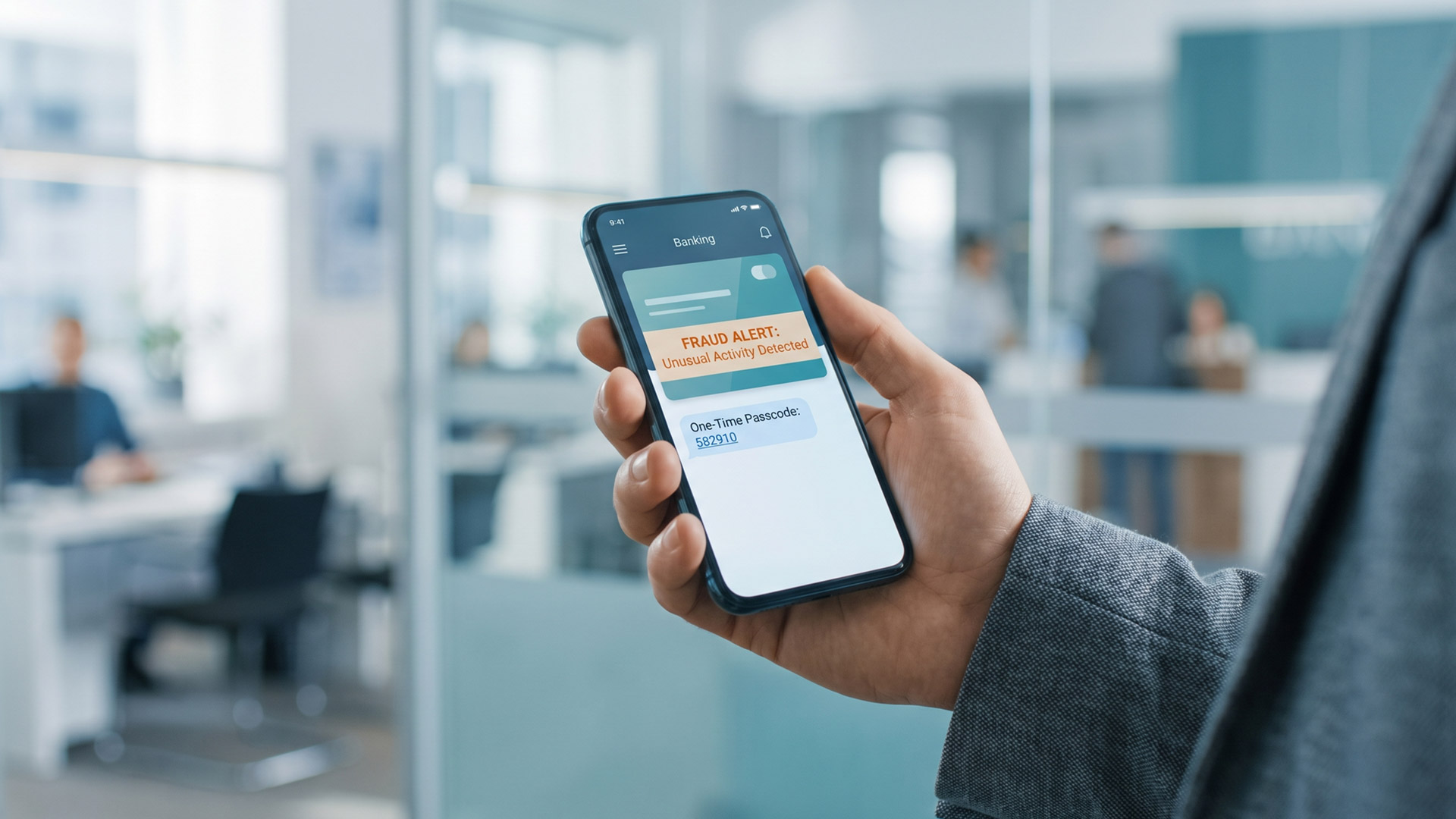
Fraud alerts notify account holders of suspicious transactions in near real time, and the mechanism depends on low end-to-end latency: a message delivered minutes late defeats the purpose of the alert. Financial institutions typically register fraud alert campaigns separately from marketing campaigns under 10DLC, since mixing use cases on a single registered campaign is a common cause of post-approval filtering. The content itself must avoid embedded links where possible, since unsolicited links in financial messaging are a common phishing vector that carrier filters actively scan for. Institutions should also route fraud alert traffic through carrier connections with consistently high delivery receipt accuracy, since a delayed or silently dropped fraud alert can leave a compromised account exposed longer than necessary.
Two-Factor Authentication.
One-time passcodes sent by SMS remain the dominant second factor for online banking and payment authorization despite the rise of app-based authenticators, largely because SMS requires no additional app installation. OTP traffic is typically registered as a distinct campaign type under 10DLC and is exempt from marketing consent standards, since it is triggered directly by a consumer action rather than sent unprompted, though documented consent to the underlying account relationship still applies. OTP message content should be brief and formulaic, since carrier filters trained to recognize legitimate one-time-passcode traffic patterns can flag messages that deviate from expected structure. See Monty Mobile's finance industry solutions for OTP-specific delivery configuration.
Transaction Confirmations.
Transaction confirmations, including payment receipts and transfer notifications, fall under the informational messaging category rather than promotional, meaning implied consent through the existing account relationship is generally sufficient rather than requiring express written consent. Financial institutions should nonetheless document the basis for that implied consent, since the distinction between informational and promotional content is a frequent point of dispute in TCPA litigation when a confirmation message includes any cross-sell language. Institutions that route both categories through the same messaging platform should keep confirmation templates strictly informational, since even a single promotional line inside an otherwise transactional message can shift the entire message into the higher consent standard. Clear internal content review before a template goes live is a lower-cost safeguard than defending the distinction after a complaint has already been filed.
Regulatory note: Mobile banking and financial services are subject to regulatory requirements in each operating jurisdiction. Financial product availability, terms, and conditions vary by market.
Healthcare: Appointment Reminders, Prescription Alerts
Text message reminders have a measurable, peer-reviewed impact on care delivery. According to The Permanente Journal (2022), in a randomized study of 125,076 primary care visits at Kaiser Permanente Washington, an additional text message reminder reduced no-shows by 7 percent and same-day cancellations by 6 percent, a meaningful improvement given the scale of most outpatient scheduling operations. That evidence base is a major reason healthcare organizations have adopted transactional SMS as core scheduling infrastructure rather than an optional convenience feature.
Appointment Reminders.
Appointment reminders are informational messages triggered by a scheduled visit, and consent is typically captured at the point of scheduling when the patient provides a mobile number for that purpose. Providers should register reminder campaigns as a distinct 10DLC use case from any promotional health system communications, since mixing patient care messaging with marketing content on the same registered campaign increases both filtering risk and compliance scrutiny. Reminder timing also matters operationally: sending a single reminder close to the appointment date captures fewer of the available benefits than a scheduled sequence sent at multiple intervals before the visit. See Monty Mobile's healthcare industry solutions for scheduling-system integration options.
Prescription and Refill Alerts.
Prescription-ready and refill-due notifications are similarly informational in nature but carry additional sensitivity because message content can reveal health information about the recipient. Providers should avoid including medication names or diagnostic detail directly in message text where a more general notification, directing the patient to a secure portal, achieves the same outcome without exposing protected content to anyone who might view the recipient's lock screen. Consent for these alerts is typically captured through the pharmacy or care management intake process rather than through a separate SMS-specific opt-in, though the stated purpose at collection should explicitly cover prescription notifications. Providers using a shared messaging platform across appointment reminders and refill alerts should still register each use case separately, since the two carry different content sensitivity profiles even though both are informational.
Regulatory note: Healthcare messaging involving protected health information is subject to HIPAA and applicable state health privacy laws in addition to TCPA and carrier registration requirements. Consult qualified compliance counsel before sending patient-specific health content by SMS.
Retail and Logistics: Order Confirmations, Delivery Tracking
Order status updates represent a substantial and growing share of enterprise transactional volume. According to Coherent Market Insights (2026), Customer Relationship Management services, which include order status updates and support notifications, are projected to hold roughly 40 percent share of the enterprise A2P SMS market in 2026, reflecting how central transactional messaging has become to post-purchase customer experience in retail and logistics.
Order and Shipping Confirmations.
Order confirmations sent immediately after checkout are informational messages tied directly to a transaction the consumer just completed, and consent is generally established through the checkout process itself when the consumer provides a mobile number for order updates. Retailers should still capture and timestamp that consent, since the point at which a number was collected and for what stated purpose becomes evidence in the event of a dispute. Retailers running both order confirmations and promotional SMS from the same checkout flow should present them as separate opt-ins, since bundling a required transactional number field with an unrelated marketing opt-in checkbox is a frequent source of consent disputes. See Monty Mobile's retail and ecommerce solutions for checkout-integration guidance.
Delivery Tracking Updates.
Delivery tracking messages, including out-for-delivery and delivered notifications, are typically the highest-volume transactional category for retail and logistics senders and are frequently the first message type to trigger 10DLC throughput limits if registered under an undersized campaign tier. Enterprises with high seasonal peaks, particularly around major shopping periods, should register campaign throughput at a tier that accounts for peak-day volume rather than average daily volume, since carriers apply message-per-second caps at the campaign level regardless of registered brand size. Logistics providers sending tracking updates on behalf of multiple retail brands should also confirm whether each underlying brand needs its own registered campaign, since carriers generally expect the disclosed sender identity in the message to match the registered brand rather than the logistics platform operating behind it. Planning throughput capacity several weeks ahead of a known peak period is materially easier than requesting an emergency tier increase once volume has already started climbing.

Deployment Example: Financial Services Transactional SMS During a Card Reissuance Campaign
A mid-sized US regional bank operating across three states needed to notify approximately 40,000 cardholders of a mandatory card reissuance following a third-party payment processor incident. The bank's existing SMS program was registered under a single mixed-use 10DLC campaign that combined promotional offers with account notifications, a configuration that had produced inconsistent delivery rates during high-volume sends.
Ahead of the reissuance campaign, the bank separated its transactional and promotional traffic into distinct 10DLC campaigns, registering the account-notification campaign under a use case specifically describing fraud and security alerts. Message content was written to avoid embedded links, directing cardholders instead to call a verified number or log into the existing banking app, reducing the likelihood of carrier content filtering associated with unsolicited financial links.
Over a nine-day send window, the campaign achieved a delivery rate above 97 percent to registered mobile numbers, with the majority of messages delivered within seconds of submission. Call center volume related to the reissuance dropped notably after the second day of the campaign as cardholders self-served through the referenced channels rather than calling for status updates.
Note: This is an anonymized deployment scenario based on typical implementation outcomes. Specific results vary by implementation, audience quality, and market conditions.
Compliance Requirements for Transactional SMS Providers in the US
Enterprises evaluating a transactional SMS provider for US traffic should confirm the provider supports registration and consent management across four overlapping frameworks.
Monty Mobile's SMS Management Platform includes built-in campaign registration workflows and consent-record retention, reducing the operational burden of managing TCPA, CTIA, and 10DLC requirements as separate manual processes.
Getting Started: Transactional SMS Infrastructure for US Enterprises
- 10DLC Brand and Campaign Registration. Register the sending brand's legal entity details and register each distinct transactional use case, such as fraud alerts, appointment reminders, or order confirmations, as a separate campaign rather than combining them under one registration.
- Consent Documentation and Opt-Out Infrastructure. Capture and retain the timestamp, medium, and stated purpose of consent for every recipient, and configure automated handling for STOP, HELP, and common-language opt-out requests at the platform level.
- Direct Carrier Route Selection and DLR Monitoring. Select routing paths with direct carrier interconnects where volume justifies it, and monitor delivery receipt accuracy continuously rather than relying on submission confirmation alone as a proxy for delivery.
- Compliance Monitoring and Ongoing Audit. Review registered campaign content against actual message content periodically, since carriers increasingly match live traffic against registered samples and can filter compliant campaigns that have drifted from their original registration.
Enterprises evaluating a transactional SMS provider for US traffic can contact Monty Mobile to review current registration timelines, route options, and compliance tooling for their specific use case.
Transactional SMS compliance is one component of a broader A2P messaging strategy for enterprises operating in the US. For a deeper look at route quality and monetization, see also: International A2P SMS Monetization (https://montymobile.com/products/channels/sms-messaging/).

About the Author
Daniel Dib is Senior Brand Manager at Monty Mobile, leading campaign strategy, content development, and go-to-market execution across the company's CPaaS, Travel eSIM, and A2P Wholesale SMS product lines.
Frequently Asked Questions
What is the difference between transactional and promotional SMS?
Transactional SMS is triggered by a specific action the recipient already took, such as placing an order or scheduling an appointment, and it delivers information related to that action. Promotional SMS is unprompted and intended to drive a sale or marketing action. The distinction matters because promotional content requires express written consent under the TCPA, while transactional content is generally covered by implied consent from the underlying relationship.
How much transactional SMS volume can a 10DLC-registered number handle?
Throughput limits are set at the campaign level based on the registered use case and brand trust score, not by the number itself, and they range from a few messages per second for lower-trust campaigns to significantly higher throughput for verified, established brands. Enterprises with high-volume transactional traffic should register throughput tiers that account for peak sending periods, not average daily volume.
Do healthcare providers need special consent for transactional SMS?
Healthcare providers generally rely on consent captured at the point a patient provides a mobile number for appointment or care-related communication, but message content involving protected health information carries additional obligations under HIPAA and state health privacy laws beyond standard TCPA and 10DLC requirements. Providers should consult compliance counsel before including any diagnostic or medication-specific detail in message text.
What happens if transactional SMS is sent without 10DLC registration?
Multiple carrier and industry sources report that major US carriers have moved to blocking unregistered A2P 10DLC traffic outright since early 2025, rather than filtering only a portion of it, meaning messages sent from an unregistered number often do not reach recipients at all. Beyond delivery failure, unregistered traffic can also result in carrier fines and campaign suspension, independent of any separate TCPA consent exposure.